
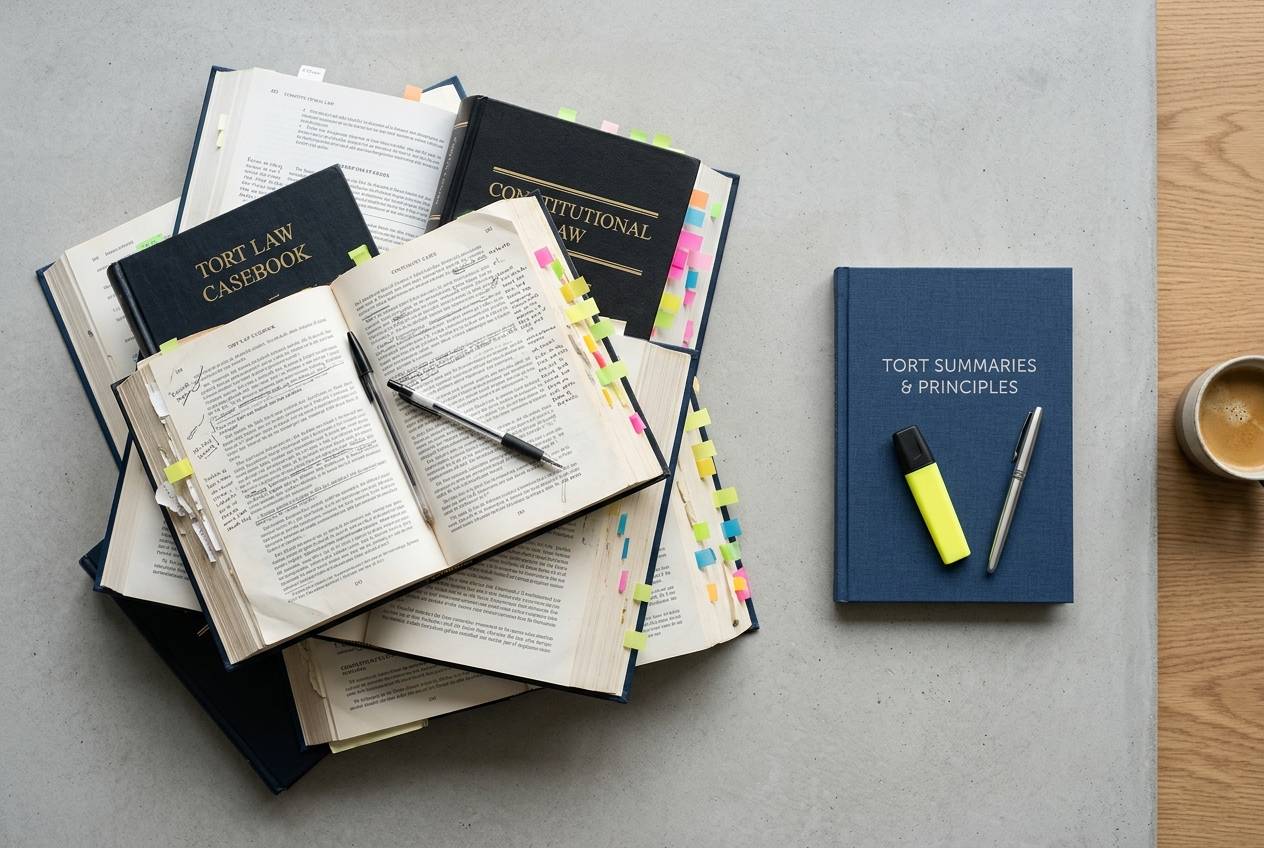
Look, trying to rote-learn every single judge’s obiter dicta in Tort law is a guaranteed way to burn out before Christmas. The reality is your examiner doesn’t care if you know what colour the snail in the ginger beer bottle was. They care if you can apply the ratio to a messy problem question.
Ditch the textbooks for ratio extraction
If you’re reading Winfield & Jolowicz cover to cover, you’re playing a losing game.
It’s 1,200 pages of padding. Feed your reading list into Claude or ChatGPT and order it to extract the ratio decidendi for your core cases.
Tell the AI to act like a cynical QC: “Give me the legal principle of Caparo v Dickman, max 50 words, skip the historical context.”
Boom. You just saved three hours.
Stop typing out facts you’ll never use
Students waste weeks building colour-coded spreadsheets of case facts. Forget that.
Facts are only useful as ammunition to distinguish your exam scenario from the precedent.
Limit yourself to three bullet points per case: who sued whom, what was the trigger, what did the court decide. If your notes on Palsgraf look like a novel, hit delete and start again.
Game the problem questions
Tort exams are just poorly disguised maths tests.
There is a rigid formula for duty, breach, causation, and damages. Take a past paper, dump it into your AI of choice, and ask it to break the scenario down using the IRAC method.
Use the output to map out the red herrings examiners love to throw in. Stop writing essays when the marker just wants a legal equation solved.
The “Underground” Pro-Tip 💡
Create a custom GPT trained exclusively on your university’s specific marking rubric and the last five years of past examiner reports. Prompt it with: “Analyse my answer against the 2023 Tort examiner report and flag anywhere I’ve written waffle instead of applying precedent.” It forces you to write to the exact biases of the people grading you.
Stop acting like a Victorian clerk copying manuscripts and start treating your degree like a data extraction exercise.
Blog
This section offers a summary of the blog, presenting a range of articles, perspectives, and materials to educate and motivate readers.
-
Ditch the revision timetable: Let AI prioritise your weakest topics
Stop painting textbooks neon and start learning. Use active recall, blurting and past papers to…
-
Manual research is a mug’s game: The ruthless way to strip insights from papers
Stop treating AI like a magic wand. Master persona prompting, use marking rubrics as cheat…
-
Stop acting like a human photocopier: The modular stack for skipping the library rot
Stop guessing your grades. Use AI to simulate marking rubrics, automate Harvard referencing and mirror…

Leave a Reply