
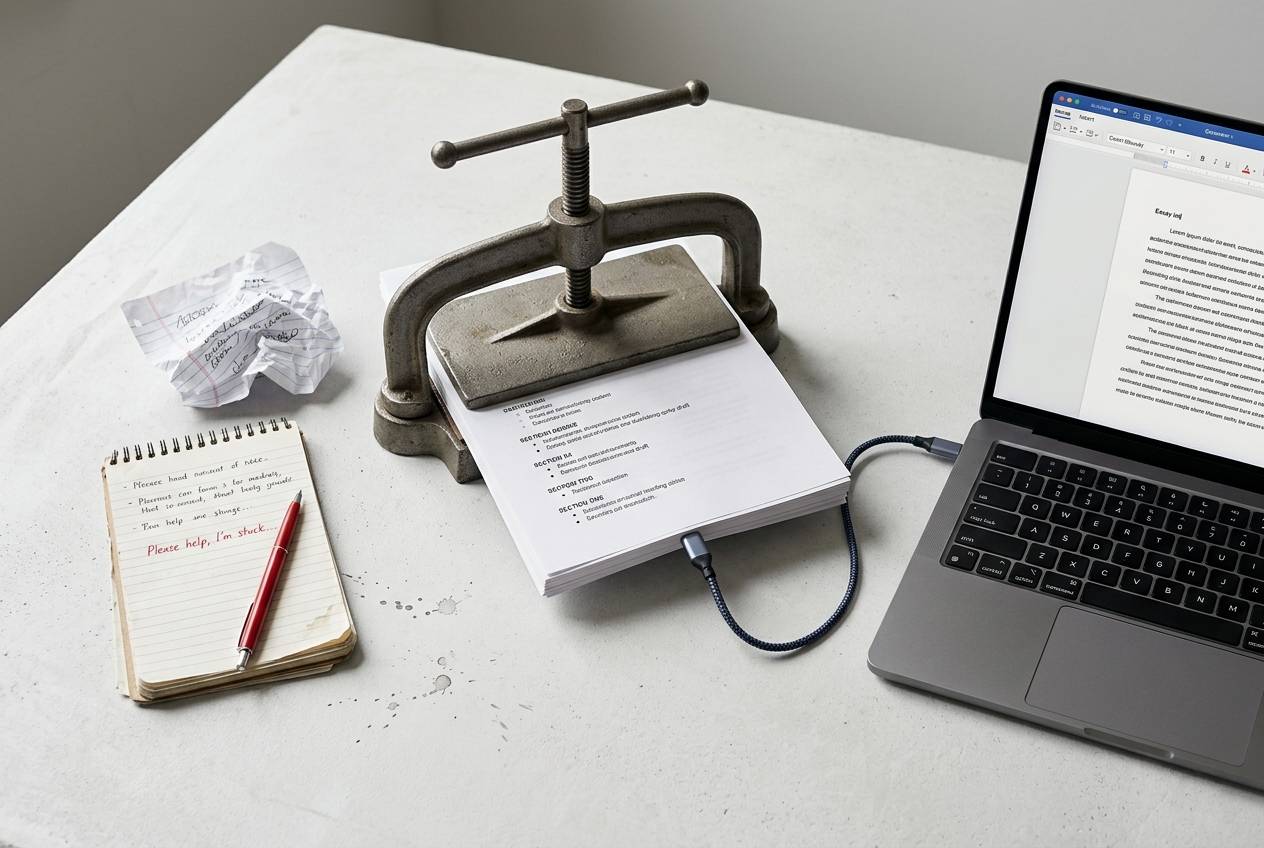
Most students use ChatGPT like a magic 8-ball and wonder why the output is a pile of lukewarm, generic rubbish. You’re spending more time “fixing” the AI’s flowery prose than it would have taken to just write the bloody thing yourself.
Look, if you’re still saying “please write an essay about X,” you’re doing it wrong. You aren’t asking a favour; you’re programming a tool.
Stop treating the bot like a human
The reality: AI doesn’t know what a good UK undergraduate essay looks like until you feed it the criteria. If you don’t provide the marking rubric and three examples of your own writing style, you’ll get back a mid-tier American high school paper every single time. Force the model to adopt a specific persona—a skeptical academic with a penchant for concise British prose—before you even mention the topic. This is best for killing the “bot-voice” before it starts, ensuring you aren’t stuck spending five hours deleting “delve” and “tapestry” from your work.
Build the skeleton, not the skin
Forget asking for a full draft in one go. That’s how you end up with 2,000 words of repetitive fluff that says absolutely nothing. You need to modularise the process. Order the AI to generate a structural outline based on specific lecture notes, then force it to argue against its own points to find the nuance your tutors actually care about. By prioritising the logic of the argument over the word count, you ensure the final output actually has some backbone.
The evidence-first mandate
The university system is obsessed with citations, yet the bot is prone to hallucinating “sources” that don’t exist. Stop the hallucination by using a “Source-Grounding” prompt where you paste your reading list and forbid the AI from using any outside information. It’s the fastest way to maximise your marks without the risk of a disciplinary hearing because you cited a book that was never written.
The “Underground” Pro-Tip 💡
Use “Reverse-Outline Prompting” to fix your drafts: Paste your messy, half-finished essay and tell the AI: “Identify the three weakest logical leaps in this text and rewrite only those sections using the PEEL (Point, Evidence, Explanation, Link) structure.” It forces the AI to act as a ruthless editor rather than a creative writer, which is the quickest shortcut to a 2:1 or a First.
The library is for people who haven’t figured out how to use a terminal; get your prompts right and go home.
Blog
This section offers a summary of the blog, presenting a range of articles, perspectives, and materials to educate and motivate readers.
-
Ditch the revision timetable: Let AI prioritise your weakest topics
Stop painting textbooks neon and start learning. Use active recall, blurting and past papers to…
-
Manual research is a mug’s game: The ruthless way to strip insights from papers
Stop treating AI like a magic wand. Master persona prompting, use marking rubrics as cheat…
-
Stop acting like a human photocopier: The modular stack for skipping the library rot
Stop guessing your grades. Use AI to simulate marking rubrics, automate Harvard referencing and mirror…

Leave a Reply